Month: December 2012
13) Types of rainbows in the sky

Primary rainbow
This is the most commonly seen in the sky. It forms 40 to 42 degrees of anti solar point (an imaginary point opposite to the sun). If there are smaller reflective droplets, only violet color will be visible.
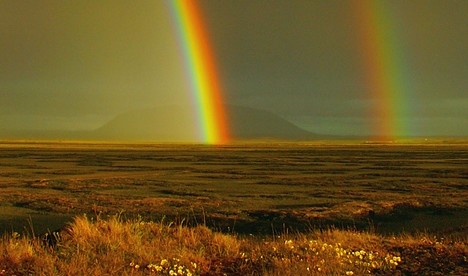
Secondary rainbow
A secondary rainbow cast outside or next to the primary rainbow. It appears to be lighter than the primary. It has a double reflections in the water droplet, also known as Alexanders Dark Band.
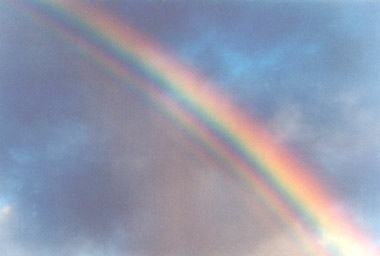
Supernumerary rainbow
This is a special rainbow. It needs interference of light rays of different wavelengths to be formed. It appears on the inside of a primary rainbow and it is faint in color. The faint pastel streaks of color also form outside the secondary rainbow though it is rare.
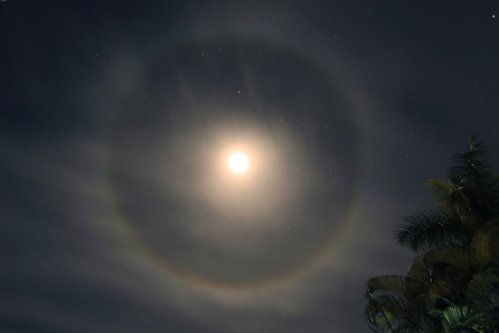
Lunar rainbow
This rainbow is not form by sunlight but moonlight. It appears on the Lunar month when the moon is nearly full, form by the light from the surface of the moon, reflecting in tiny droplets that cause the refraction and stream of color eventually. It usually appears in a white faint bow on the outer rim of the moon.
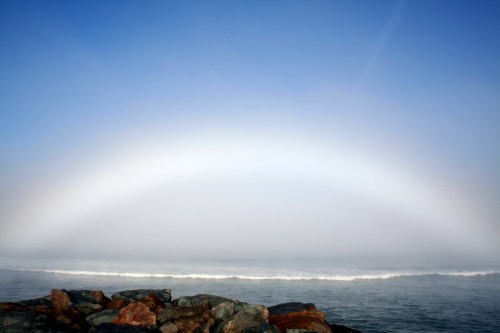
Fogbow
This particular rainbow is not formed by rain but fog. This happens when water droplets are too tiny for light to pass through in the same manner as in a normal rainbow. And when inadequate color dispersion of light takes place, it results in a white band known as white rainbow.
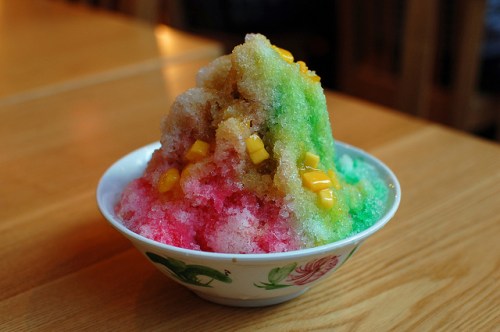
“Ice Kacang” rainbow
A local desert popular in Malaysia and Singapore. Ice Kachang (Ice Beans) contains jelly, red beans, sweet corn and palm seeds, topped with shaved ice, condensed milk and Rainbow colored syrups. Take this on hot weather will certainly put a rainbow smile on your face!
39) 2 sculptures by the bridge
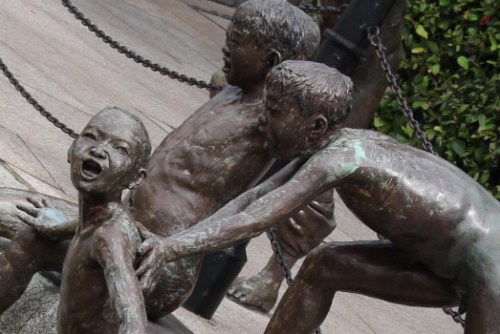
On the left of the Cavenagh Bridge, along the fringe of the Singapore River, there are 5 bronze naked boys frolicking, driving off the bridge for a swim.
This First Generation sculpture halted the movement of olden days kids playing along the river while the river is still polluted by mud and garbage. It is a common sight during those days where children swing on trees and take plunge into the river, an uncommon sight these days.

Sculptor, Chong Fah Cheong designed this lovely piece depicting scenes of early days Singapore. You can see the scene played out all over Asia, though the young laughter of the boys were heard no more.
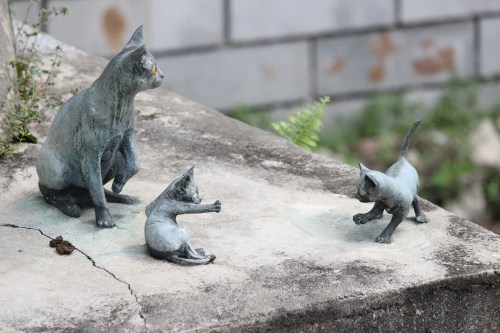
On the right corner of the bridge, a family of Singapura Cat rest themselves there. Kitty mama watches over her 2 lovely kittens frisking happily by the side, though 1 of her kittens was stolen.

Kitty mama guards the heart of Singapore day and night, never missed a single movement along the busy riverside.
38) It’s big, but it’s not the Sesame Street Big Bird!

Where do we see this round butt?
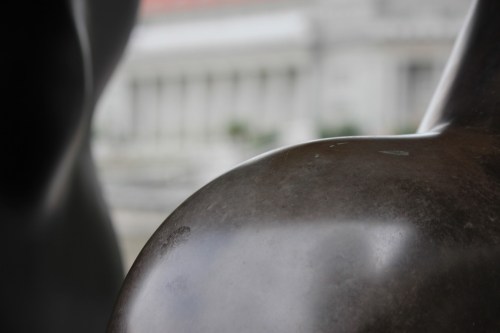
Or is this something else?

“Bird” sculpture is made of bronze, created by renowned sculptor, Fernando Botero. This beautiful 3-dimension art piece signifies the joy of living and the power of optimism. It has a “vital statistic” of 245 x 310 x 250 cm and is located outside UOB Plaza, next to Singapore River.
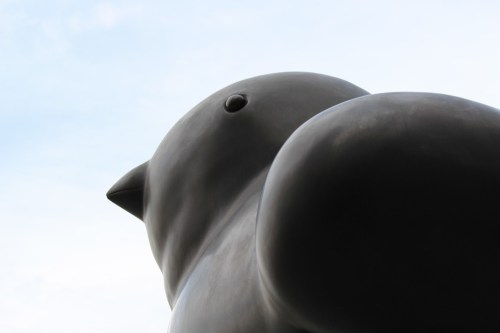
UOB (United Overseas Bank) believes so long as there is peace and optimism, the nation will continue to grow and prosper.

Personally, I like its shape in round form. It epitomizes an eternal strength and inspiring hope to every passerby.

“Bird” join tip with the UFO-like Supreme Court

Viewing through “Bird” underneath is the 5-star Fullerton Hotel, it’s a breezy view.

“Bird” under the blue sky, waiting to take wing.
37) Brother Bridges to Chinatown
There are two bridges leading us from the direction of east to Chinatown.
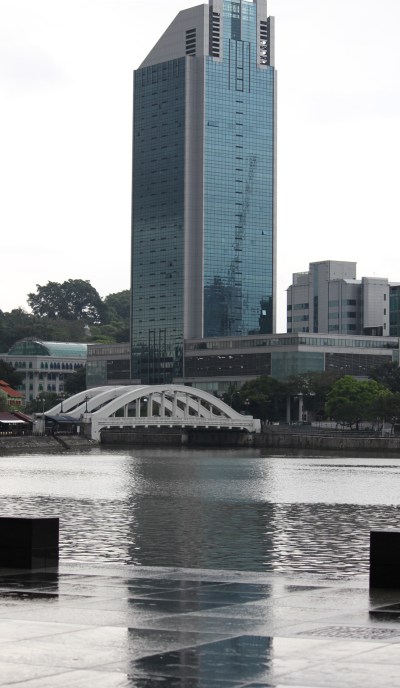
One is on the left, the “Elgin Bridge”, while the one on the right is “Coleman Bridge”.

Elgin Bridge was built as an unnamed footbridge in 1819. The existing bridge was built in 1929 and named after Lord Elgin (Governor-General of India). It was the first bridge across Singapore River that linked two roads to Chinatown core, South Bridge Road and North Bridge Road.

The second one is Coleman Bridge, which was built in 1840. It was the second bridge built across the Singapore River. Designed and named after an Irish, George Drumgoole Coleman, Singapore’s first architect.
In 1865, the original brick bridge was replaced by timber. And in 1886, an iron bridge was built to replace the wooden one.
To withstand the increasing heavy traffic flow, the iron bridge was finally demolished in 1986 and replaced with the present concrete bridge while the iron lamp post and railing were retained under historical conservation.
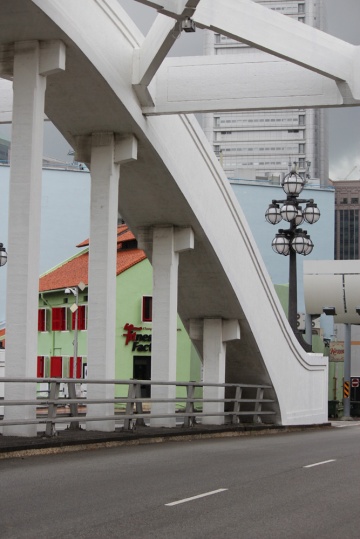
Day and night, Elgin Bridge stood still as strong as an iron man, bearing travelers without any complaints.

Ferry with tourist sight seeing the landscape of Singapore River.
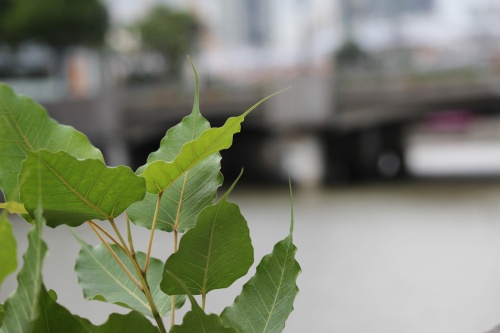
The little Bodhi tree witnessing the hustle and bustle of our footsteps and the history of the two bridges in the heart of the Singapore river.
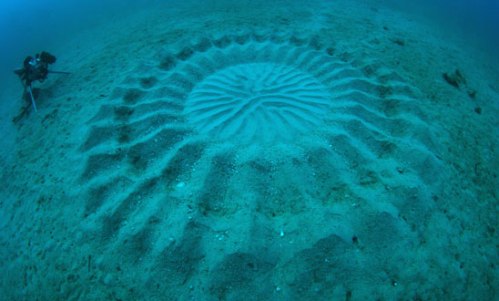
12) UFO or USO (unidentified submerged object)?

Is this geometric composition done by UFO or USO? Could it be even man-made?

None of the mentioned did it. It is the puffer fish’s work of art.

Male puffer fish attracts the opposite sex by crafting this “mysterious circle”. This art piece measuring about 6.5ft in diameter is eventually going to be their love nest. According to scientist, the more ridges the circle contained, the more likely more female fishes will be attracted.

This amazing craftsmanship was discovered by a Japanese freelance underwater world photographer, in the semi-tropical region of Amami Oshima.
More information of this article can be found at http://www.spoon-tamago.com/2012/09/18/deep-sea-mystery-circle-love-story/
13) The 3 special features on a Signalized Pedestrian Crossing

Green Man+ is specially addressed to the needs to elderly and Pedestrians With Disabilities (PWD) as this group of pedestrians need more time to cross the road. This is done by tapping the CEPAS-compliant senior citizen concession card or Green Man+ card on the reader (mounted on the traffic light pole). Once the reader verifies the valid card, the system will extend ‘Green Man’ time from 3-12sec depending on the size of the crossing and volume of traffic.
This gratifying thoughts designed by LTA (Land Transport Authority) enable the needy pedestrians enough time to finish the crossing at a gentle pace.

The beeping sound pedestrians hear at pedestrian crossing also known as Pedestrian Audio Signal is to ease the visually disabled cross the road. The volume of the audio signals is adjusted automatically based on the noise level of the surrounding environment.

The Green-Man Countdown Timers indicate the amount of time left in the crossing phase. As balancing the safety of pedestrians is as important as keeping the road smooth-flowing, the timers are usually not standardized. It counts on the length of crossing, the volume of pedestrians and the density of the traffic flow.
Thus, it is good to understand the operation needs, so you wouldn’t be standing under the hot sun waiting and start punching the pole.
11) Who named the “King of Fruits”!

Regarded by many as the “King of Fruits”; durian, is native to Brunei, Indonesia and Malaysia. British naturalist, Alfred Russel Wallace famously described its flesh as “a rich custard highly flavoured with almonds”.
During his stays in Malay Archipelago (1869) Wallace described “to eat durians is a new sensation, worth a voyage to the east to experience’.

The flesh is best when it’s ripe, though it can also be consumed at various stages of ripeness. The unripe fruit makes good vegetables. It is also used to flavour wide variety of Southease Asian cuisines. The seeds can be eaten when cooked.

Durian is a spiky round or oblong husk containing pods in yellow custard-like fruit. The trees are tall and straight. Durians orchards are danger zones often covered with nets. As the fruit strikes a man in its fall is strong enough to kill.
The fruit emits a pungent distinctive odour, you either like it or hate it. It has a very unique character. Some regard it as pleasantly fragrant; others find the aroma disagreeable. The odour has led to the fruit’s banishment from hotels, airline cabin and public transportation.
It is no wonder Wallace the “father of biogeography” in the letter to Sir William Jackson Hooker stated – “If I had to fix on two only as representing the perfection of two classes, I should certainly choose the Durian and the Orange as the king and queen of fruits.”

Durian flowers are usually closed during the daytime, I believe it is because the King needs more rest than others!
- ← Previous
- 1
- …
- 3
- 4
 AddGrainOnEarth